

 Products
 Bars
Bars
 Beads & Spheres
 Bolts & Nuts
 Crucibles
 Discs
Discs
 Fibers & Fabrics
 Films
Films
 Flake
Flake
 Foams
Foams
 Foil
Foil
 Granules
 Honeycombs
 Ink
Ink
 Laminate
 Lumps
Lumps
 Meshes
 Metallised Film
 Plate
Plate
 Powders
 Rod
Rod
 Sheets
 Single Crystals
 Sputtering Target
 Tubes
Tubes
 Washer
 Wires
Wires
 Converters & Calculators
 Write for Us



Advantages and Disadvantages of Marker Band Materials for Medical Uses
Various materials are employed for the production of marker bands, and the selection of the right material has a critical role in the success of the procedure. These are very important for the purpose of visibility during certain diagnostic procedures, including X-rays, MRI, or fluoroscopy. These assist in the positioning of certain devices, particularly in procedures such as minimal invasive surgery.
The essay below presents the advantages and disadvantages of different types of marker bands made of platinum-iridium, gold, platinum, tungsten, tantalum, and polymers.

Fig. 1 Different Types of Alloy Stents [1]
1. Platinum-Iridium Alloy
Platinum-iridium alloy materials blend the advantageous properties of platinum with enhanced strength and resistance provided by iridium. They are ideal for long-term implants in a biomedical application.
The combination of platinum and iridium produces a marker band that is extremely corrosion- as well as oxidation-resistant. This ensures stability within the body. However, it is also costly, being one of the most expensive options available. Additionally, this marker band is extremely hard, leading to challenges in manipulation.
These alloys of platinum and iridium are highly suitable for complex biomedical applications where high durability and precise imaging are required. They are used in the form of balloon catheters, stent delivery systems, and in many complex systems where constant vision and reliability are essential.

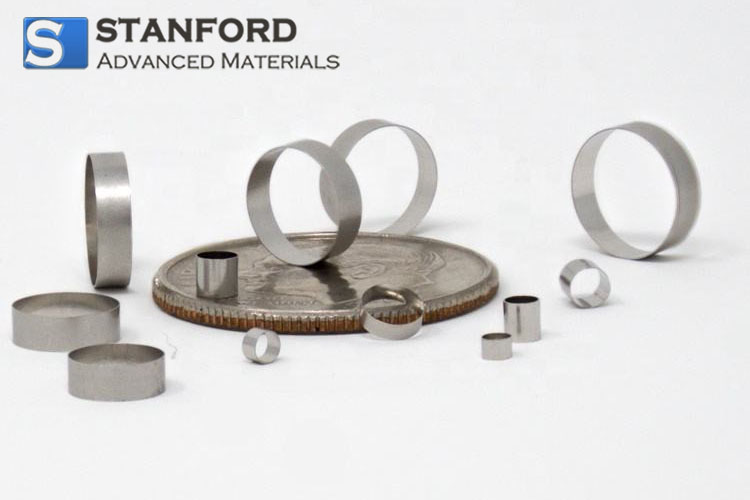
Fig. 2 Platinum Iridium Marker Bands
2. Gold Marker Bands
Gold, which has traditional value in medicine, remains one of the preferred materials for marker bands because of its excellent radiopacity and biocompatibility.
Gold functions effectively in medical markers due to its ability to produce very clear and bright images in X-ray imaging. It also exhibits high biocompatibility, thus reducing the likelihood of reactions in the body. However, it is soft and deforms under pressure, a characteristic that may compromise its suitability in high-stress environments. It is also expensive.
Gold bands or markers can be found in precise medical tools such as neurovascular instruments and coronary guidewires. Gold is radiopaque; therefore, it aids in guiding stents or catheters during delicate medical procedures.
3. Platinum Marker Bands
Platinum is frequently used for marker bands due to its excellent radiopacity and biocompatibility.
It can withstand extreme conditions while maintaining durability and corrosion-resistance for an extended period. Platinum appears very visible under X-ray, ensuring accurate positioning. It is more difficult to manufacture than gold.
Platinum marker bands are ideal for implantation where visibility and biocompatibility are primary considerations. They would typically feature in pacemakers, catheters, and stents.
4. Tantalum Marker Bands
Tantalum is characterised by its high corrosion resistance and biocompatibility, thus finding various applications as a medical implant.
Tantalum effectively resists corrosion and oxidation, making it suitable for implantation purposes. It offers good radiopacity, akin to platinum, ensuring visibility during imaging sessions. Nevertheless, tantalum poses handling challenges when compared to softer metals such as gold, which increases manufacturing costs. The limited availability of tantalum compared to other metals may also contribute to its high cost.
Tantalum marker bands are employed in long-term implanted devices like orthopedic implants, stents, and other biomedical implants where long-term service life and visibility are required.
Related reading: Case Study: Application of Tantalum Marker Band in Medical Devices
5. Tungsten Marker Bands
Tungsten is known to be a heavy and robust metal, renowned for its excellent radiopacity properties, making it an appealing choice for marker bands.
Tungsten's radiographic properties aid clinicians in accurately locating the placement of devices. Furthermore, the metal displays stability due to its higher density, making it useful in situations where the device must remain stationary. However, the brittleness of the material may limit its applications.
Tungsten serves as a preferred material for applications necessitating strong radiographic properties, primarily driven by its high atomic number and density, which facilitate excellent X-ray attenuation. This positions tungsten as an essential material in various radiographic and imaging technologies, including X-ray tubes, radiation shielding, and medical imaging equipment.
6. Polymer-Based Marker Bands
Marker bands made from polymer materials are gaining traction due to their flexibility, lightweight properties, and cost-effectiveness.
They are lightweight, allowing for easy handling during the manufacturing process. Polymers are comparatively inexpensive when contrasted with metals, but they exhibit lower radiopacity. This quality renders them unsuitable for certain medical imaging procedures. Moreover, they possess potential for degradation, which could make them inappropriate for long-term implants.
In applications that do not necessitate high radiopacity or durability, polymer band markers are commonly utilised in the form of temporary guidewires or catheter markers. These band markers serve as a cost-effective option in applications where visibility is required but durability is less critical.
Comparison Table and How to Choose
|
Material |
Pros |
Cons |
Typical Applications |
|
Platinum-Iridium |
Excellent radiopacity, highly durable, corrosion-resistant |
Expensive, hard to shape |
Balloon catheters, stent delivery systems |
|
Gold |
Superior radiopacity, excellent biocompatibility |
Soft and prone to deformation, expensive |
Neurovascular devices, coronary artery guidewires |
|
Platinum |
Excellent durability and corrosion resistance, high radiopacity |
Expensive, soft compared to other metals |
Pacemakers, catheters, stents |
|
Tungsten |
High radiopacity, stable, dense |
Brittle, less biocompatible than other materials |
Guidewires, catheter shafts |
|
Tantalum |
Highly corrosion-resistant, excellent radiopacity, biocompatible |
Difficult to manipulate, expensive |
Orthopedic devices, long-term implants |
|
Polymer |
Lightweight, cost-effective, easy to manipulate |
Low radiopacity, not suitable for long-term implants |
Temporary guidewires, disposable catheters |
In conclusion, the choice of marker band material depends on the specific requirements of the medical procedure, including radiopacity, biocompatibility, durability, and cost. While metals such as platinum, gold, and tantalum offer strong performance in imaging and biocompatibility, polymers and tungsten can provide cost-effective or specialised solutions for temporary uses. For more medical devices, please check Stanford Advanced Materials (SAM).
Reference:
[1] Vanaei, S.; Hashemi, M.; Solouk, A.; Asghari Ilani, M.; Amili, O.; Hefzy, M.S.; Tang, Y.; Elahinia, M. Manufacturing, Processing, and Characterization of Self-Expanding Metallic Stents: A Comprehensive Review. Bioengineering 2024, 11, 983.

 Dr. Samuel R. Matthews

