

 Products
 Bars
Bars
 Beads & Spheres
 Bolts & Nuts
 Crucibles
 Discs
Discs
 Fibers & Fabrics
 Films
Films
 Flake
Flake
 Foams
Foams
 Foil
Foil
 Granules
 Honeycombs
 Ink
Ink
 Laminate
 Lumps
Lumps
 Meshes
 Metallised Film
 Plate
Plate
 Powders
 Rod
Rod
 Sheets
 Single Crystals
 Sputtering Target
 Tubes
Tubes
 Washer
 Wires
Wires
 Converters & Calculators
 Write for Us



How Much Gold Can An IPhone Refine?
In 1973, mobile telephone inventor Martin Cooper took the first portable wireless telephone and placed a call on the streets of New York City. This event marks the inception of mobile telephony, which has contributed significantly to modern communication.
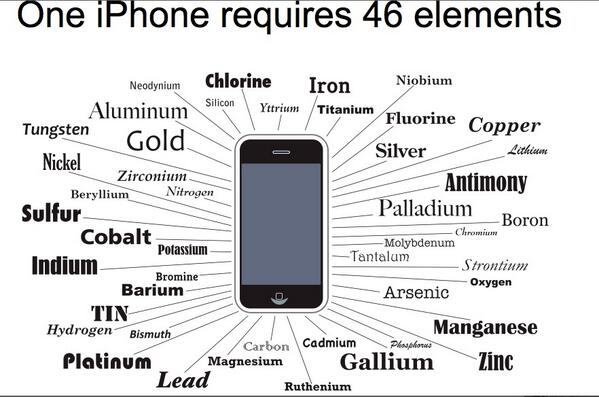
After over 40 years of development, the device has been reduced from dimensions similar to two bricks to a form that can be operated with one hand. Although the phone appears simple, it contains a complex internal structure. Every material is composed of chemical elements, and the mobile phone is no exception.
Tin and Lead
Tin and Lead are the two principal metals on the mainboard. Tin–lead alloys have been the most cost‐effective soldering material that meets the requirements for solder quality and post-solder reliability. Consequently, every chip and circuit board is soldered with tin and lead. Lead-containing mixtures can harm human health and the environment, and the industry now uses lead-free soldering with tin combined with Copper and Silver.
Silicon
Silicon is used to produce chips for mobile telephone processors. Each chip is cut from a complete silicon wafer. The processing of silicon wafers is highly complicated. The material must be cleaned, oxidised, heat-treated and implanted with ions. The multiple processes introduce measurable differences, which result in varying operating frequencies in identical processor models.
Tungsten
Tungsten is used for the mobile vibrator. It is chosen for its high density, hardness and wear resistance, which are vital given the high-speed rotation of the vibrator. Moreover, Nickel is used in the manufacture of microphones. Praseodymium, Gadolinium and Neodymium are applied in microphones and loudspeakers; Copper is the main raw material for internal wiring; and Tantalum serves as the primary component of microcapacitors.
What about Gold? Many components on the mainboards contain gold. The conductors, chips, IDE interfaces, PCI-Express slots, additional interfaces and processor sockets are often coated with a thin gold layer, measuring a few micrometres in thickness. The SIM card that is used also contains gold.
Is it then possible to exchange an old mobile phone for its gold value? The answer is no. Although several mobile phone components contain gold, the overall content is very low. According to the UN e-waste report, approximately 41 phones collectively contain 1 gram of gold. Given the current gold price, the gold content in an individual phone is valued at no more than US$2.
 Chin Trento


